
What Serbia's Student Protests Expose About the Evolution of Authoritarian Power
A year of student protests against populist leader Aleksandar Vučić in Serbia exposes the evolution of populist authoritarianism and underscores the urgent need for new strategies to resist it.
ANALYSIS
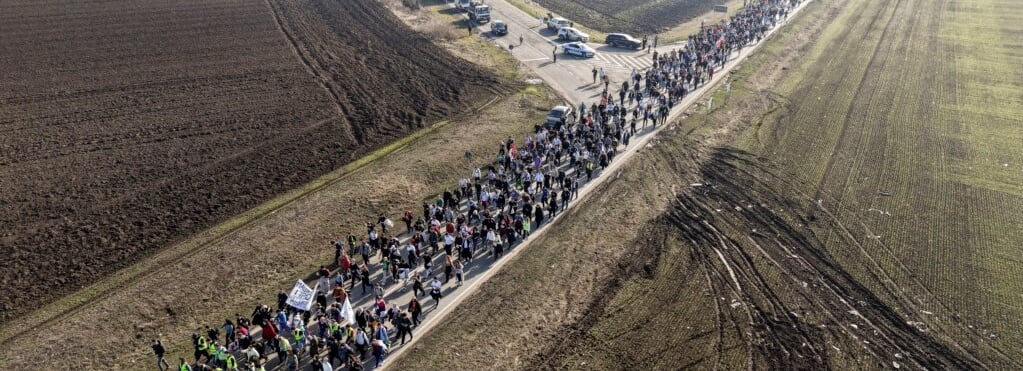
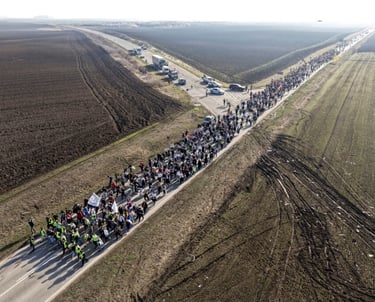
On a rain-lashed day in March 2025, a small group of young Serbians pressed forward along a rural road in the country’s interior, their figures bent against the wind as sheets of rain swept down from Rudnik Mountain. The video of their march, circulated on a Viber channel I had somehow found myself added to, carried a terse caption that read:
"Our heroes and liberators on the way to the largest protest ever in Serbia, March 15 in Belgrade.
They will not give up until our demands are met. Let's welcome them as they deserve!"
According to comments below the post, the marchers were students from Užice and Čačak. They had chosen to walk more than 150 kilometres across treacherous mountain roads. They were bound for Belgrade to join what many described as a make-or-break moment in nearly five months of student-led protests against Serbia’s authoritarian-populist president, Aleksandar Vučić. The movement had erupted in early November 2024, after the collapse of the newly renovated canopy at Novi Sad’s central station killed sixteen people.
The station, repeatedly unveiled in staged ceremonies to bolster the election campaigns of Vučić’s Serbian Progressive Party, collapsed into public view as more than a failed infrastructure project. It laid bare the political machinery behind it – a web of patronage, impunity, and institutional decay – no longer deniable, even to those who had spent eleven years looking the other way.
Turmoil over democracy in Serbia has mostly been drowned out by the louder crises consuming liberal democracies elsewhere. Beyond a Madonna's Instagram post and a brief segment on Rachel Maddow’s show on MSNBC, it has barely registered in the American media. Aleksandar Vučić has been remarkably adept at courting political establishments abroad, presenting himself as the steady hand keeping a once-volatile Balkan state anchored – neither drifting towards Moscow nor sliding back into the chaos of the 1990s. To many in Western capitals, Serbia is still seen as a country that never quite completed its democratic transition after Milošević’s fall, and thus offers limited lessons for established democracies now grappling with their own authoritarian turns.
Once viewed as a Balkan aberration, Serbia's 1990s slide into authoritarianism now looks prescient. It was there that Slobodan Milošević perfected a durable model of illiberal rule. He understood the value of maintaining a democratic façade, holding multiparty elections even as he undermined their integrity. He tolerated a press, so long as he could throttle any truly independent voices. He allowed an opposition to operate, provided it was structurally barred from ever gaining real power.
What scholars now theorise as the electoral authoritarianism or hybrid regime – systems that combine meaningful democratic institutions with systematic incumbent abuse, yielding electoral competition that is real but unfair – is, in essence, the very governance model Milošević had already operationalised.
Milošević’s former information minister, Aleksandar Vučić, has proven a far more subtle operator. After rebranding himself as a pro-European reformer, he has become a connoisseur of what Nancy Bermeo describes as democratic backsliding: the slow, methodical erosion of institutions from within. Rather than seizing the press, he has co-opted it through opaque ownership and the leverage of state advertising. Rather than abolishing judicial independence, he has subverted it by filling the courts with loyalists. And rather than crushing civil society, he has neutralised it through patronage and selective funding, ensuring that while its shell remains, its capacity for dissent is gone.
By 2019, when Freedom House officially downgraded the country, it was simply acknowledging a fait accompli: Serbia’s democracy had already been hollowed out.
Politics of Victimhood
What makes Serbia's strongman politics particularly relevant to international audiences is not the mechanics of their power consolidation – which are hardly unique – but these leaders' instinct to weaponise the theatrics of victimhood. Long before Trump's rallies transmuted the resentment of America's "forgotten" into the capture of the Republican Party, Milošević was staging mass spectacles that cast him as the saviour restoring Serbia's wounded national dignity.
A decade later, as the fragile, incompletely secured democracy that followed his fall began to fracture, his former apprentice Vučić experimented with a different strain of victimhood: the leader as champion of the dispossessed. On television, he unloads boxes of discounted groceries, vows to shield "ordinary people" from profiteers, and publicly castigates supermarket chains – a performance of left-populist paternalism. Yet weeks later, he orchestrates military exercises on the Kosovo border, stage-managing nationalist confrontation. His ability to move fluidly across ideological terrain reveals the core adaptability of authoritarian populism: the leader casts himself as the indispensable bulwark against whatever threat happens to be most useful at the time.
Much of the current wave of Serbia’s uprising against Vučić’s government can be read as one populist performance answering another. If Vučić casts himself as the nation’s tireless caretaker, the man who worries, provides and suffers on behalf of “his people”, the students have replied with a rival morality play. Marching hundreds of kilometres through rain and over mountain terrain, they present their endurance as proof of love for a country they see as betrayed. It is a contest of suffering, two competing claims to the role of saviour. The echoes of the 1990s are unmistakable. Like the students who once marched against Milošević – most famously the activists of Otpor! (“Resistance”), whose influence rippled far beyond Serbia’s borders and inspired a generation of pro-democracy movements – today’s students use these marches to dramatise the pain they believe their generation must bear to redeem the nation.

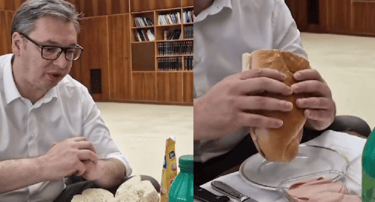
Aleksandar Vučić fulfils his promise and has breakfast of ‘parizer’ (sausage) and bread at the Palace of Serbia, alongside ministers Siniša Mali and Toma Momirović, to show the price of basic goods has been lowered. Instagram / Budućnost Srbije.
Barefoot Through History
Victimhood, though it may appear to be the universal costume of populist politics, is no mere accident in Serbia’s political culture. As sociologist Ivana Spasić shows, Serbia’s attachment to its own suffering is a product of centuries of storytelling. It reaches back to the memory of the 1389 Battle of Kosovo, where military defeat at the hands of the Ottoman Empire was transformed into moral triumph. From that moment, loss was reimagined as proof of righteousness; endurance and pain became the moral foundations of belonging. Over the centuries, this “Kosovo covenant” turned into what Spasić calls an “ongoing practical accomplishment” — a story continuously performed, reinterpreted, and redeployed across politics, religion, and popular culture. It has served as both trauma and triumph, allowing Serbs to imagine themselves as history’s victims and its chosen survivors at once.
Few episodes in Serbian history capture the emotional core of this national story as clearly as the country’s response to the Austro-Hungarian invasion during the First World War, above all, the episode known as the Great Retreat. In the winter of 1915–1916, encircled by Austro- Hungarian, German, and Bulgarian forces, the Serbian army – joined by thousands of civilians – began a desperate withdrawal across the snowbound Albanian mountains.
Starving, sick and exposed to the cold, hundreds of thousands of Serbs set out across the mountains in the winter of 1915–16, fleeing the invading Austro-Hungarian, German and Bulgarian armies. Only a fraction reached the Greek coast alive. The image of the barefoot soldier crossing ice and stone endures in Serbia’s collective memory, crystallising an idea of resistance as the capacity to suffer, to endure and somehow to prevail against the impossible.
Over the past quarter-century, each new generation of students has reached instinctively for that same language of endurance, as if protest itself required a measure of physical trial. In the late 1990s, the activists of Otpor! twice walked the eighty kilometres between Belgrade and Novi Sad, waving flags and beating drums while villagers along the way offered food, shelter and rakija, turning the ordeal into a travelling carnival of defiance.
In the latest wave of student demonstrations, that ritual has only become more elaborate. Marchers have set off from provincial towns towards the capital, some claiming routes of hundreds of kilometres, and at one point a small group even announced they would walk all the way to Brussels to deliver their demands to the European Union. Pro-government media mocked the attempt as “staged”, insisting they had proof the students used cars along the way. But that hardly mattered. Opposition television stations broadcast their progress as if it were a national sporting event, showing their arrivals in European cities where members of the Serbian diaspora greeted them with tears, flags and homemade banners.
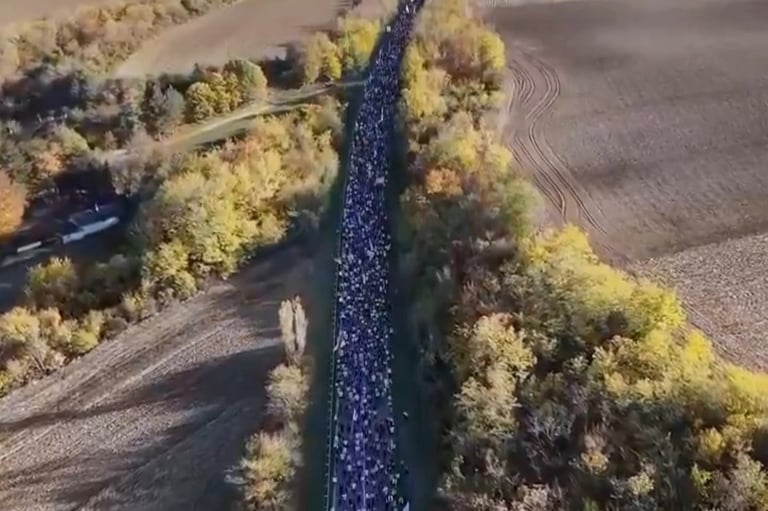
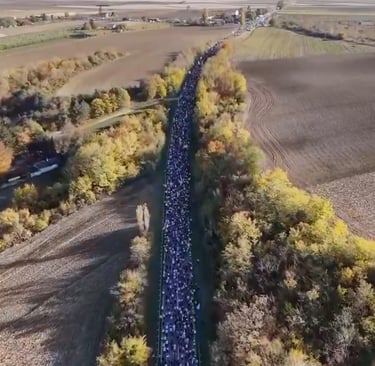
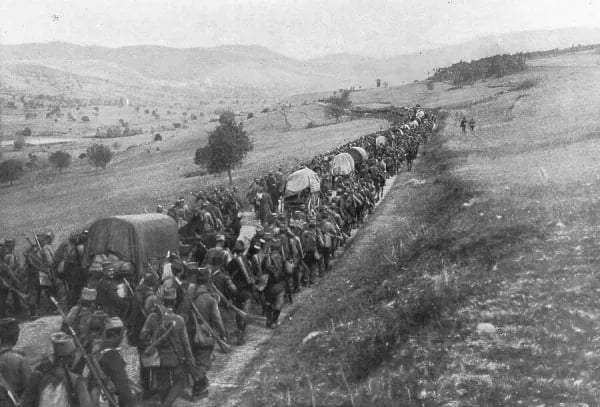
Serbian students marching towards Belgrade in October 2025 (left), and Serbian soldiers and civilians retreating through the mountains to Greece in 1916 (right)
The Diminishing Returns
Scholars of protest have long observed that acts of resistance do not emerge outside the systems they oppose, but draw upon the very cultural and symbolic resources that power itself provides. Tactics are rarely invented in isolation; they circulate, mutate and return, passing from one generation to the next in what performance scholar Diana Taylor describes as acts of transfer — the transmission of embodied knowledge, of gestures, sounds and affects that carry political memory across time. Yet when we begin to think of these acts not only as strategies but as performances, a different set of questions comes into view. It is no longer simply a matter of why they recur, but how they act upon those who witness them — how they move, persuade or fail to persuade? Do they still retain the power to disrupt, or have they hardened into rituals, repeated out of habit more than hope? What kinds of effects — emotional, political, symbolic — do they now produce, and for whom?
Two democratic uprisings in Serbia offer a glimpse of how this dynamic plays out. By the time Milošević faced Otpor!, the country had already endured a decade of economic collapse, international isolation and wars that left the region in ruins. Serbia was exhausted; its people were broke, embittered and – perhaps most crucially – convinced they were the world’s most misunderstood victims. In that atmosphere, it took little for Otpor! to find its register. The movement tapped into the public’s own sense of injury and turned it back against the state it held responsible. Milošević, never one to read the mood, did much of their work for them. Each time he ordered the arrest of a few students clowning in the streets, he vindicated their message – that they were the regime’s prime targets, and therefore its most credible opponents.
Vučić, by contrast, had been a diligent student. He’d learned that repression plays badly on camera, and that nothing revives a Serbian protest quite like the sight of students being dragged through the streets. From the first road blockades in late 2024, he avoided the heavy hand, choosing instead to let public anger run out of steam rather than feed it. The police were told to hold back, to intervene only when absolutely unavoidable, and sometimes not even then. He framed his restraint, with a touch of irony, as a refusal to grant students “the baton of salvation”, a reference to his belief that Milošević sealed his own downfall when he answered Otpor!’s provocations with force.
He also understood something just as crucial: after years of chaos, Serbia had finally settled into a spell of stability and modest prosperity. A population with steady jobs, cheap credit, and a fragile sense of normalcy was far less inclined to recognise itself in the suffering of others — even when those others were students, the country’s self-anointed moral vanguard, long treated as something close to sacred in the national imagination.
Throughout 2025, students kept trying to stir a weary public, baiting the state to bare its teeth. At times the gambit worked; more often it faded without consequence. Still, they pressed on, urged by older opposition figures who had once fought Milošević and clung to the belief that persistence would eventually pay off. That faith now feels misplaced. It may yet stand as one of the defining lessons for protest movements everywhere, including those emerging across the West.
Polling the Leash
The new strongmen have learned the syntax of our age. They govern as technologists rather than ideologues, and their craft is iteration. Theirs is a politics of perpetual adjustment, with polls in place of principles and focus groups instead of faith. Power has become a process, endlessly optimised. One week Vučić is the tribune of ordinary people, the next the sober statesman holding the country together, then the wounded patriot besieged by foreign conspiracies. He cycles through personas until one takes hold, then moves on before it curdles.
What we face today is a form of authoritarianism that listens too closely. These leaders sample dissent, measure it, and feed it back into their design. The leash is drawn only as tight as the public’s comfort allows. The strongman has become responsive. This is why comparisons between Trump and Hitler have always rung hollow. The danger now lies not in the crude seizure of power, but in its diffusion through consent, through data, through the intimate feedback loop between ruler and ruled.
To defend democracy under such conditions is to recognise how much of the past has deserted us. The familiar images of resistance, the body on the line, belong to another world, one in which oppression was visible and ideology declared itself. We now inhabit a murkier terrain where power masquerades as participation and illiberalism as choice. We are, in truth, in a no man’s land, a space where the struggle for truth begins with reclaiming the very language in which we name our captivity.